Cipres Energy
A high-performance website template built to generate leads for solar energy companies.
The Challenge
Solar energy companies operate in a high-trust, high-consideration market. A homeowner or business owner evaluating a solar installation isn’t making an impulse decision — they’re committing to a 20-year relationship with a technology they probably don’t fully understand yet. The website has to do a lot of heavy lifting: build credibility, explain the process, showcase real completed projects with real numbers, and make it easy to take the next step.
Most solar company websites fail at this. They rely on stock photos of panels on rooftops, vague promises about savings, and contact forms that feel like filling out a tax return. Cipres Solar was built to be the opposite — specific, data-driven, and visually confident enough to match the scale of what solar companies actually do.
Design Process
The design direction was clear from the start: industrial strength meets modern clarity.
Solar installations are physical, technical, real-world projects. The design had to reflect that weight without feeling heavy or dated:
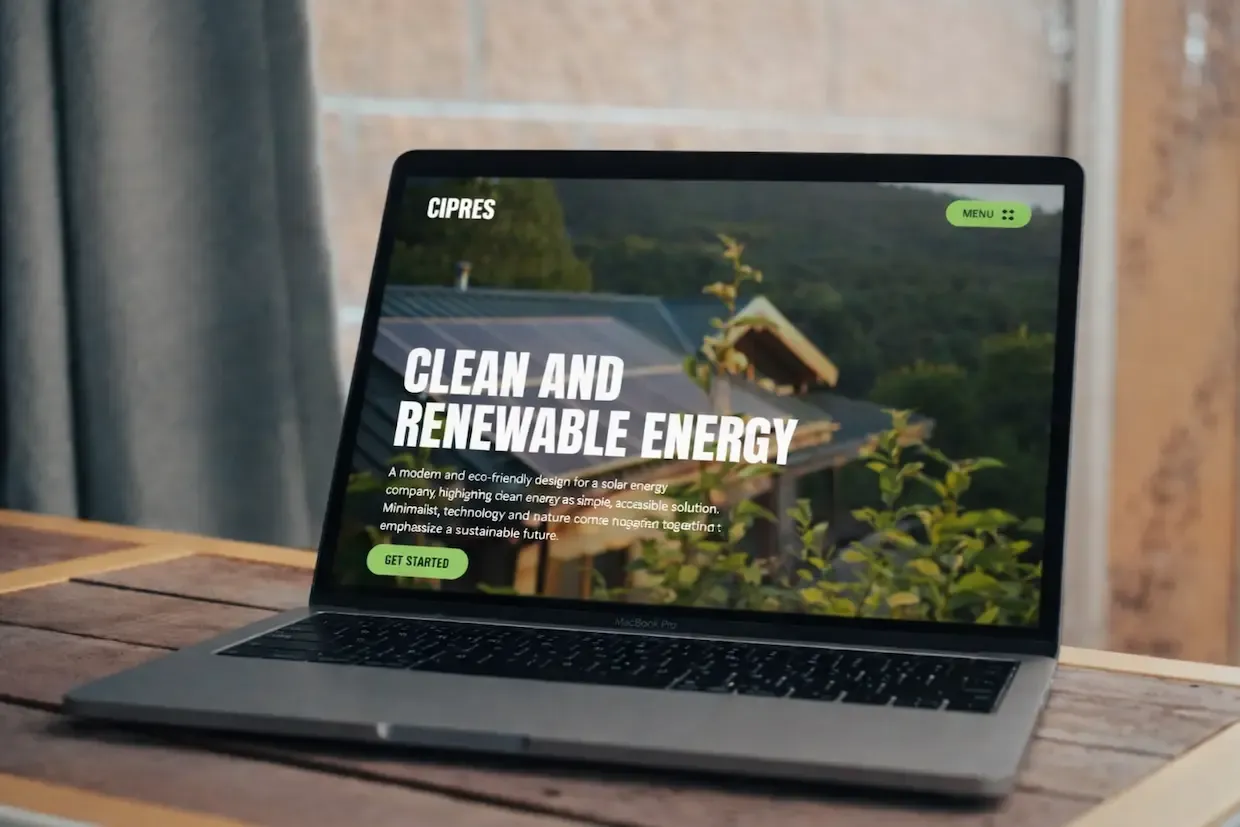
- Video backgrounds on every hero section to immediately communicate the scale and energy of solar infrastructure
- A projects section built around data — each installation shows panel count, capacity, CO2 saved per year, energy generated, and payback period front and center
- Category filtering across four installation types — Residential, Commercial, Community, and Industrial — so prospects can find work that mirrors their own situation
- A work process section on the homepage to walk visitors through exactly what happens from consultation to installation
- A dedicated About page with a FAQ section to handle the most common objections before they become reasons not to call
Typography was kept clean and functional — this isn’t a creative studio, it’s an infrastructure company. The visual personality comes from the video backgrounds and the project data, not from decorative typography.
Technical Decisions
Cipres Solar required a fundamentally different content schema than any of the previous templates — the project data model had to carry real technical and financial information:
| Tool | Why |
|---|---|
| Astro 5 | Static-first with SSR, ideal for content-heavy pages |
| React 19 | Powers the carousel, hover effects, and interactive form |
| GSAP + Lenis | Scroll-triggered animations and smooth video hero transitions |
| Tailwind CSS v4 | Fast, consistent design system across all pages |
| Resend + Rate Limiting | Production-grade contact form with honeypot and request throttling |
| Netlify Adapter | SSR deployment with Netlify’s image CDN for optimized project photos |
The project content schema was the most involved part of the build. Each project carries capacity, panelCount, co2Saved, energyGenerated, and paybackPeriod as structured fields — not buried in markdown prose, but surfaced as typed data that can be displayed consistently across cards and detail pages. Optional challenges and solutions arrays give solar companies a structured way to tell the story of each installation without writing free-form content from scratch.
The contact form security also got more attention here than in previous templates — honeypot fields, rate limiting via Upstash, and server-side email validation layered together to protect against spam without adding friction for real prospects.
The Result
Cipres Solar ships as a complete, production-ready website for solar energy companies:
- Four core pages — Home, About, Projects, Contact
- Video backgrounds on every hero section
- Projects with category filtering — Residential, Commercial, Community, Industrial
- Rich project detail pages with technical specs — capacity, panel count, CO2 saved, payback period
- Optional challenges and solutions sections per project
- Work process timeline on the homepage
- FAQ section with accordion on the About page
- Contact page with working hours, phone, email, and social links
- Multi-layer contact form security — honeypot, rate limiting, email validation
- Partner logos section
- Automatic sitemap and full SEO meta tags
- Legal pages out of the box
The data-rich project pages are the standout feature — seeing “32 panels, 12 kW system, 9.4 tons of CO2 saved per year, 7-year payback period” on a real completed installation is more persuasive than any marketing copy.
Lessons Learned
Building for a specific industry forced a level of domain thinking that generic agency templates don’t require. I had to ask: what does a solar company actually need to prove to a prospect? The answer wasn’t just “we do good work” — it was “here are the exact numbers from a job like yours.”
Data is design. The most impactful design decision in this project wasn’t a color choice or a layout — it was structuring the project schema to surface real technical and financial metrics prominently. That data does more conversion work than any hero section.
The multi-page video background approach also surfaced performance challenges I hadn’t anticipated. Videos need careful loading strategies — autoplay, muted, poster fallbacks, and lazy loading — to avoid hammering page load times on slower connections. Getting that right across three different hero sections required more iteration than expected.
What I’d Do Differently
A few things I’d revisit looking back:
- A savings calculator — an interactive tool where visitors input their monthly electricity bill and get an estimated ROI would be a natural fit for this template and a significant conversion driver. It’s the kind of feature that turns a brochure site into a sales tool.
- Before/after project imagery — a slider component showing the installation site before and after would make the project pages far more compelling than static gallery images alone.
- Multilingual support — solar companies often operate across regions with different languages. A built-in i18n setup from day one would make this template significantly more useful internationally without requiring a major refactor.